
I remain very interested in the idea of diverse plantings in our orchards and gardens. Reading research about the benefits of flowers in orchard systems speaks to what I feel seems logical for many reasons.
Taking it another direction, I recently listened to a podcast with John Kempf, which focused on vineyards, but with information also pertinent to most perennial crops, which would of course include fruit trees! The focus on plant and root physiology was of particular interest to me, with mention of the work from Dr. James White of Rutgers University.
Recent research has shown that plant root tips are very porous, and can absorb bacteria, fungi, and microalgae. These micro-organisms go into the spaces between cells, and into the actual cells of the plant, including the fruits and seeds. The minerals from the microbes, and the microbes themselves are utilized by the plant, and the plant gives sugars to the microbes to take back to the soil. Research is indicating that the microbes exiting the root tips help to create the root hairs, and the root hairs communicate through electrical and chemical signals to the microbes what nutrients the plant needs. Microbes make the return trip into the plant transporting specific needed minerals and “sphingolipid rafts” (think waxy green leaves) which support the growth and health of the plant.
In an optimal balanced situation, the plant can supply the sugars needed by the microbes, and the microbes can supply the minerals and lipids the plant needs to grow, for example as happens in a forest. A key difference in a forest, compared to a vineyard or orchard, is the diversity of plants in a forest. Quorum sensing is a communication system that allows microbes to communicate and coordinate their behaviors, directly impacting the nutrients and sugars that can be transported. In an established forest, a critical threshold of diversity in plants and microbes is available to promote quorum sensing. In managed plantings, reaching a diversity threshold may be more challenging.
Building up the soil microbiome requires sufficient sugars from a diversity of growing plant roots, sufficient water, moderate temperatures, and absence of toxins or damaging interventions.
Diverse covercropping, or companion planting, in perennial systems, utilizes plants that have complimentary nutritional needs, water requirements, and root structures. In turn this system provides greater sun capture and photosynthesis with more diversity of sugars being provided to the soil through roots of differing depths and structures.
Plant diversity with mixed plantings or covercropping, leads to microbial diversity, which can lead to quorum sensing, which can lead to an integration of plant and microbial communication, collaboration, and even intelligence.
Mr Kempf states that vineyard or perennial soil biology is commonly suppressed through three primary means:
- Bare soil exposed to sun, with heat killing the microbiome.
- Application of chemical fertilizers which are high in salts and electolytes, causing cellular oxidation.
- Fungicide application, which damages the soil fungal networks.
(In the past, I have also heard him include tillage and glyphosate as microbial suppressors.)
Though no hard data is available to be certain, an observational estimate for required plant diversity to establish the threshold for quorum sensing, is 5 to 8 plant families. I was amused to find that ChatGPT could provide an easy listing of plants families suitable for companion or cover cropping in an orchard setting:
- Legumes: clover, fava, vetch, cowpea
- Grasses: Oats, barley, teff
- Mustards: daikon radish, forage mustard
- Borage: phacelia, comfrey, common borage
- Umbel flowered: dill or fennel
- Aster: calendula, sunflower, chicory
- Buckwheat: annual, or perennial. Also perennial sorrel.
- Amaranth: Quinoa, orach, or lamb’s quarters
Others might include flax and sesame. A great resource for cover crop information is the website Green Cover.
While thinking of diversity within the orchard, with multigrafted trees, remember the orchard floor as well, and happy planting!
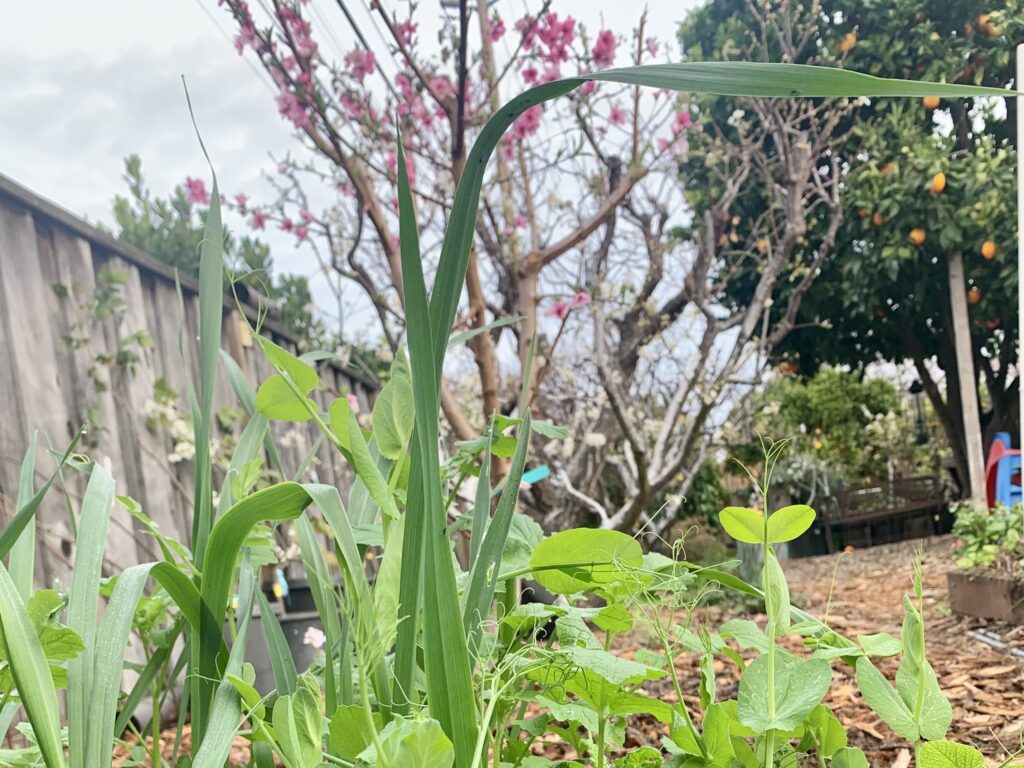
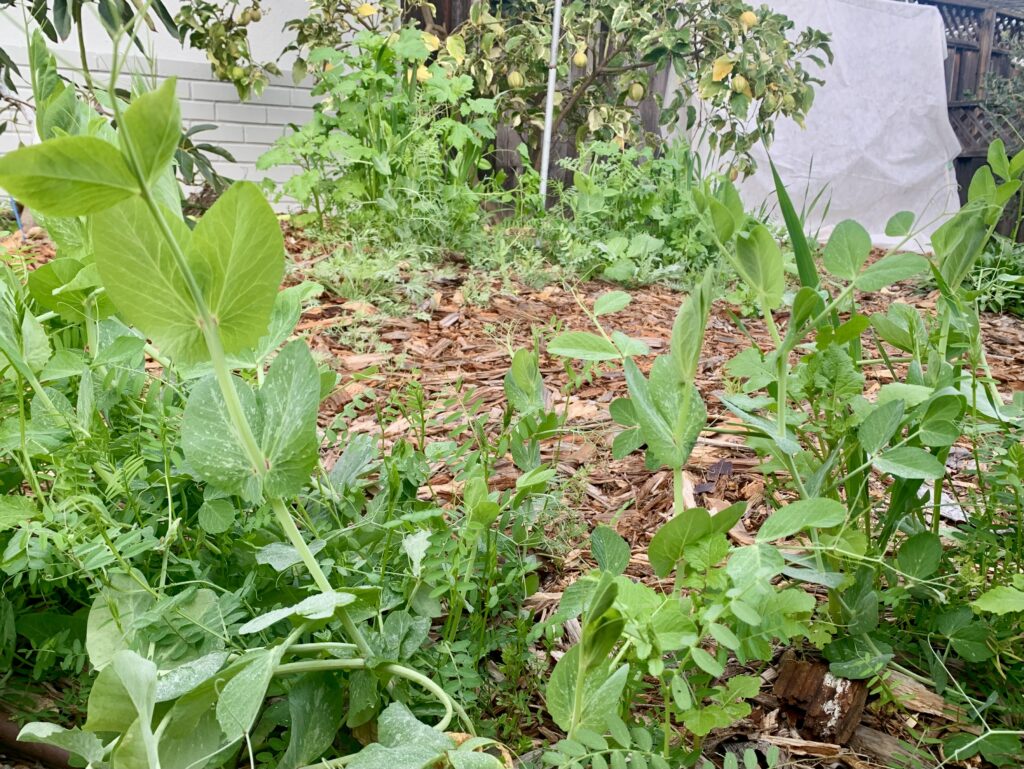
These images show the difficulty of adding covercrop into a heavily mulched orchard!