
As expressed in the title of the prior posting, I am feeling diversity is of key importance! I have been encouraged by recent articles and webinars, to keep pushing for more diversity in my garden and among the fruit trees. A striking realization for me, is that more diversity above ground means more diversity below ground, which means better microbiome (endosphere) within the plants. Trees with an improved microbiome have been shown to have improved tolerance to disease and pest pressures.
In our own garden and orchard, I have deliberated between living ground cover and thick layers of wood chip mulch. I do believe that either is better than bare soil for plant health and soil health. The wood chips facilitate an abundance of decomposing saprophytic fungi which help break down the woody organic matter and return it to the soil. However, that may be overlooking the importance of mycorrhizal fungi, which are associated with living roots. These fungi help to unlock nutrients available in the soil, and utilize sugars (carbon) provided by the roots in the soil. A difficulty I have experienced is helping to establish growing roots through the still quite thick wood mulch. Transplanting plants with established roots seems more successful.
In my effort of trying to incorporate more plants growing around the fruit trees, I am focusing on perennial flowering plants, with the additional goal of promoting habitat for increased insect diversity. Beneficial insects and arthropods tend not to travel far to do their work, so interspersing flowering plants among the trees allows for better predation and pollination. Again, diversity of plantings allows for more diversity of food source and shelter for a broader range of predators, parasitoids, and pollinators. The location of flowering plantings can be under trees, in alleyways, and in hedgerows close by to the trees. Optimally, flowering happens for an extended time through most of the year, hosting a variety of beneficial insects which require pollen and nectar, as well as pest insects as a food source.
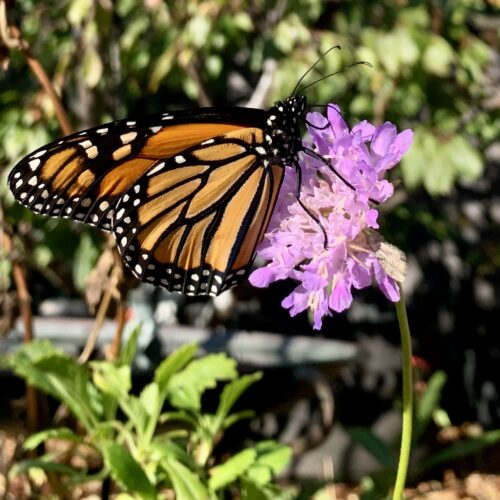
Perennials (and annuals) growing around the trees, are actively photosynthesizing and thereby contributing to mycorrhizal connections at multiple soil depths with the roots of the fruit trees. The root exudates develop soil aggregation, and structure, allowing for improved water and air movement in the soil, and movement of carbon into the soil. The improved soil microbial diversity improves the plant rhizosphere and endosphere, contributing to improved tree health and disease resistance. As an example of improved tree resistance, it is possible for citrus trees grown in Florida in very healthy soil to test positive for HLB, but to not suffer from the disease.
Soil moisture is a commonly expressed concern in our area, due to low rainfall, or limited water availability. Covering the soil with thick layers of mulch is a proven way to limit evaporation. There is growing evidence that a diverse cover crop builds soil better than mulch alone, and promotes better water absorption, and water cycling around the plants by decreasing evaporation.
What type of flowers then? I want to consider early, and late flowering, accessible nectar and pollen, a variety of heights for shelter, tolerance to some shade since they are near to or under trees, not invasive, and perhaps native to our area. I want flowers with an open structure, and perhaps extra-floral nectaries as food sources for natural enemies. Perennials may have longer root systems and more developed fungal networks than annual plants, so perhaps even more desirable for me. A list of perennials I have successfully tried so far includes: achillea, allysum, aquilegia, campanula, erigeron, heuchera, nepeta, California ranunculus, and veronica. It will be good fun to research more perennials, bulbs, and annuals to try!